
What We’re Learning: The Next American Revolution by Grace Lee Boggs with Scott Kurashige
Some books remain on our shelves because they offer answers. Others stay with us because they continue asking worthwhile questions. The Next American Revolution: Sustainable Activism for the Twenty-First Century by Grace Lee Boggs with Scott Kurashige belongs, for me, firmly in the latter category. 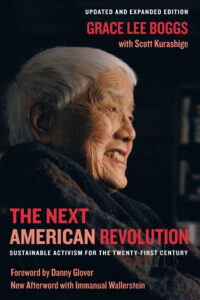
I recently pulled the book back off my shelf because I found myself craving a perspective rooted not only in critique, but in imagination. Boggs spent much of her life asking what becomes possible when people move beyond reacting to the world as it is and begin creating the world they hope to see. Published in 2011, it grapples with challenges that continue to shape our world today: economic inequality, environmental degradation, political polarization, and the growing sense that many of our institutions are struggling to meet the moment. Yet rather than focusing primarily on these challenges themselves, Boggs asks a more enduring question: How do societies change?
For those unfamiliar with her work, Grace Lee Boggs was a philosopher, writer, and activist whose life spanned nearly a century of American history. Born in 1915 to Chinese immigrant parents, she spent more than seventy years participating in and reflecting on movements for labor rights, civil rights, community development, and social transformation. Much of her work was rooted in Detroit, where she witnessed firsthand both the promise and the upheaval that accompanied dramatic economic and social change.
By the time The Next American Revolution was published, Boggs had spent decades observing how communities respond to disruption, uncertainty, and possibility. The result is a book that feels less like a manifesto and more like a reflection from someone who has devoted a lifetime to studying how people adapt, organize, and imagine new futures.
Despite its title, the book’s understanding of “revolution” may surprise some readers. Boggs is less interested in the seizure of power than in the transformation of communities, relationships, and the ways we understand our responsibilities to one another. Throughout the book, she argues that many of today’s challenges cannot be addressed solely through protest or policy change. They also require imagination, experimentation, and a willingness to create new ways of living and working together.
One of the book’s most memorable themes is the distinction between reacting to problems and building alternatives. Boggs returns repeatedly to the idea that meaningful change is not simply about identifying what is broken. It is also about cultivating what might come next.
This perspective shapes much of the book. Rather than offering a single blueprint for social change, Boggs highlights examples of community gardens, neighborhood organizations, educational initiatives, and local efforts to strengthen civic life. These examples are not presented as universal solutions, but as reminders that lasting change is often rooted in ordinary people taking responsibility for the places and communities they call home.
The book also challenges readers to reconsider how we define progress. In a culture that often measures success through growth, efficiency, or consumption, Boggs asks whether healthier communities might instead be measured by the quality of relationships, opportunities for participation, and a shared commitment to the common good.
What makes The Next American Revolution particularly compelling is its tone. Boggs writes with conviction…but also with humility. There is little sense that she has discovered a perfect roadmap for the future. Instead, she approaches the questions before her with curiosity, drawing on decades of experience while remaining open to the possibility that new challenges may require new ways of thinking.
While Boggs was writing about social movements rather than philanthropy specifically, one of her central questions feels relevant across sectors: How do we create the conditions for people to imagine and build a different future? Throughout the book, she argues that meaningful change depends not only on resources or institutions, but on our collective capacity to envision alternatives to the world as it is. At a time when so many challenges demand immediate attention, her insistence on imagination as a civic responsibility – and even a form of liberation – felt both timely and worth revisiting. For those working to strengthen communities, her writing offers a valuable reminder that imagining what could be is not naïve optimism. It is part of the work.
Whether readers agree with all of Boggs’ conclusions or not, her work offers a thoughtful invitation to consider how societies evolve and what role individuals can play in that process. At a time when many conversations about change are dominated by urgency and division, The Next American Revolution reminds us that transformation often begins closer to home: in the choices we make, the communities we nurture, and the future we are willing to imagine together.
As Boggs suggests, perhaps one of the most important questions we can ask is not simply what we hope to change, but what we hope to create.