
What We’re Learning: On Ecosystems, Exhaustion, and Paying Attention
Lately, I have found myself feeling overwhelmed, not an uncommon experience in the nonprofit sector these days. In those moments, I turn to reading. Not escapism exactly, but the kind of reading that steadies you, that offers a quiet reminder that complexity is not new, that people have navigated impossible contradictions before, and that clarity, when it finally comes, tends to arrive not through force but through the willingness to stop pretending.
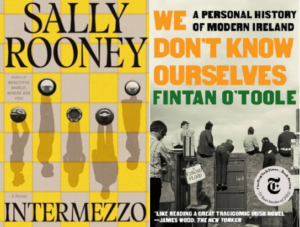
I have recently completed two books that could not seem more different and yet keep speaking to each other. Sally Rooney’s Intermezzo, a fictional portrait of despair and possibility, and Fintan O’Toole’s We Don’t Know Ourselves, a personal history of modern Ireland that is, in its own way, a portrait of the same. I did not set out to go fully Irish. But after a week spent with my mother, which is its own kind of historical fiction, I suppose I could not help myself. One book is quiet and interior; the other is sweeping and historical. At their core, though, they are about the same thing: the cost of performed certainty, and what becomes possible when you finally put it down.
That theme has been following me back to work. When we listen to our partners right now, really listen, what we hear is a community carrying significant weight. The pace of need is real. The uncertainty is real. The exhaustion on both sides of the table is real. We are not outside that ecosystem, looking in. We are inside it, shaped by the same moment, growing in response to the same forces. And yet, to assume certainty as a funder in the face of this complexity is not just hubris but harmful.
O’Toole’s portrait of modern Ireland is, at its core, a portrait of what happens when institutions perform certainty as a form of self-protection. The Ireland O’Toole writes about is one shaped by institutional fracture: economic collapse, public reckoning with abuses of power, and the slow erosion of trust in systems once treated as immovable. His work asks what becomes possible when institutions stop defending certainty long enough to confront reality. The Church, the state, the banks, each maintained a confident public face long after their foundations had cracked. That performance wasn’t just dishonest; it was actively harmful. It prevented the kind of reckoning that might have come sooner and cost less. The nonprofit sector is at a similar inflection point in which longstanding assumptions about stability, capacity, and trust no longer fully hold. Funders who project confidence, who reach for metrics and frameworks and strategic plans in ways that imply the ground beneath us is more stable than it actually is, are doing a version of what O’Toole’s institutions did. Not out of malice, but out of the very human instinct to appear capable in a moment that resists it. The instinct is understandable. In moments of strain, structure can feel safer than ambiguity. But there is a difference between using frameworks to navigate uncertainty and continuing to operate as though precision alone can resolve fundamentally unstable conditions.
Rooney’s work, in contrast, operates on a smaller, more interior scale. Her characters’ experiences highlight the contradictions that exist within us, contradictions that highlight the limitations of human capacity. They all only have so much to give. The closing of the book reads in part, “It doesn’t always work, but I do my best. See what happens. Go on in any case living.” An honest assessment and a quieter version of O’Toole’s argument…the path through difficulty is not found by demanding more certainty than the moment can offer, but by staying present inside the uncertainty itself, and moving forward.
There is something in that for the nonprofit sector right now. We are living through a moment of real strain, one that did not arrive without warning but that many of us hoped might resolve before it reached this point. The organizations doing the hardest work in the most under-resourced communities are being asked to do more with less, inside a level of uncertainty that makes multi-year planning feel almost beside the point. The exhaustion is not only programmatic; it carries an administrative and emotional weight that comes from having to justify the value of work that felt settled not long ago. And yet they persist, not because the conditions are favorable, but because the mission does not pause while the storms pass.
What we are hearing beneath that persistence is not hopelessness, but fatigue with institutional reflexes that prioritize reassurance over responsiveness. Our partners do not need funders to perform certainty back to them. They need honesty about the moment, flexibility where possible, and a willingness to remain present even when easy answers are unavailable.
If either author imparts wisdom here, it is that the institutions that emerge with integrity intact are not the ones that performed confidence through the difficulty. They are the ones that stayed honest about what they were facing and kept showing up anyway.
There is no tidy parallel; however, there is a relationship. What our partners are navigating will not resolve neatly or soon. What we are saying is simply this: paying attention is its own form of practice. For the Knott Foundation, this means listening before concluding, sitting with discomfort rather than reaching for easy answers, and acknowledging our own position in the ecosystem. Trustworthiness, whether maintained or recovered, does not come from having better answers. It comes from a willingness to see clearly what has long been easier to look away from. Not certainty, but honesty. Not resolution, but presence. The persistence of our partners deserves to be met with both. When we acknowledge that we are part of the ecosystem and not above it, we create the conditions for honest partnership, and, hopefully, meaningful change.